MicroControl Systems · Internal Test Bench

Built for one job.
Testing PumpLogic to perfection.

A custom-engineered burn-in test bench that drives ten PumpLogic controllers in parallel — exhaustively verifying every wire, every line of firmware, and every piece of hardware before a single unit ships to a customer.

12 Scenarios / unit
340+ Assertions / unit
1,440 Soak polls / unit
24 hr Burn-in soak

A test rig built
only for PumpLogic.

The Orchestrator is a custom-engineered burn-in test bench, designed and built in-house at MicroControl Systems for one purpose: making sure every PumpLogic that leaves our shop is exactly the unit the customer paid for.

It's a Docker-containerized async test harness that connects directly to ten PumpLogic controllers over the bench network and drives every API endpoint, every relay, every sensor pathway — all ten units, all at the same time. No shortcuts. No spot-checks. No skipped units.

Because it was designed for PumpLogic specifically — not adapted from a generic test framework — it knows exactly what PumpLogic should do in every situation, and exactly how to make it prove it.

Bench Status 10 / 10 ONLINE
PL-01
PL-02
PL-03
PL-04
PL-05
PL-06
PL-07
PL-08
PL-09
PL-10
12 Scenarios
340+ Assertions / device
100% Coverage / unit

What your PumpLogic
goes through before it ships.

These figures are for one single PumpLogic — your PumpLogic. The Orchestrator runs all of this on up to ten devices in parallel, but every number below reflects what gets verified on the unit you'll receive.

340+ Pass / Fail Assertions on Your Device Discrete checks against expected behavior — every comparator, every state transition, every safety lockout. All logged and tied to your unit's MAC address.
12 Scenarios / Unit Eleven functional scenarios plus the full 24-hour stability soak — every one of them run on your device.
1,440 Soak Health Polls / Unit Once-a-minute checks for 24 hours — sensors, RTC drift, heap stability, WiFi RSSI, event log integrity.
48 hr Of Schedule Replayed Time-warp injection drives your unit through two full days of schedule windows and blackout overlaps in seconds.
24 hr Continuous Burn-In A solid day of unattended operation. If your unit can't survive a day on the bench, it doesn't survive a season in the field.
60 sec Soak Poll Cadence Every minute, every metric on your device is captured and compared against tolerance.
10× Tested In Parallel Your unit runs on the bench alongside up to nine others — but its results are evaluated independently. A neighbor's failure never masks yours.
3 Failure Classes Hunted Wiring, software, and hardware — each with its own dedicated checks against your unit.
0 Defects Shipped If your unit fails any assertion or any soak poll, it does not leave the shop. No exceptions.

Three classes of failure.
Caught here. Not in your field.

Every PumpLogic that ships is hand-assembled. The Orchestrator hunts the three things that can go wrong on the bench, before they ever get a chance to surprise you in the sugarbush.

Class 1

Wiring Errors

A miswired sensor or a swapped relay lead won't hide from the threshold-flip pattern. The Orchestrator drives every signal path until it has to respond.

  • DS18B20 temperature bus continuity & addressing
  • Voltage divider input verification under live sweep
  • PSI / vacuum sensor analog signal integrity
  • 10A / 240V relay control polarity & latching
  • Connector seating & header-pin contact under load
Class 2

Software Errors

Every code path that decides when your pump runs is exercised — comparators, hysteresis, schedules, blackouts, safety lockouts. Nothing ships untested.

  • Schedule + blackout interaction (48 hr time-warp)
  • Charge-lockout state machine & recovery
  • PSI max-runtime safety + auto-disable counter
  • Settings persistence across reboot (NVS round-trip)
  • Event log integrity & chronological ordering
  • Import-validation rejection of malformed configs
Class 3

Hardware Errors

The 24-hour soak is where weak hardware reveals itself — drifting sensors, flaky power regulation, marginal WiFi radios. We find it. You don't.

  • Sensor stability over 24 hours of continuous polling
  • RTC drift within battery-backed tolerance
  • Heap stability — no memory leaks, no fragmentation
  • WiFi RSSI & reconnect behavior
  • Reboot recovery — settings preserved, state restored
  • Zero unexpected resets across the full soak window

Every unit. Every scenario.
Every single time.

All ten devices run all twelve scenarios in parallel. Each scenario produces structured pass/fail results tied to the device's MAC address.

SCENARIO 01

Settings Round-Trip

Export → import → re-export. Byte-equal verification of full configuration persistence.

~28 assertions
SCENARIO 02

Schedule + Blackout

Time-warp through 48 hours of schedule windows and blackout overlaps in seconds.

~48 assertions
SCENARIO 03

Manual Relay Control

Direct relay engage / disengage commands verified through state and live status.

~22 assertions
SCENARIO 04

Charge-Lockout State Machine

Threshold-flip drives lockout/recovery transitions; every comparator path exercised.

~36 assertions
SCENARIO 05

PSI Safety & Max-Runtime

Max-runtime cutoffs and auto-disable counter validated with simulated PSI events.

~34 assertions
SCENARIO 06

Event Log Integrity

Chronological ordering, no truncation, no corruption — across rapid event bursts.

~24 assertions
SCENARIO 07

Graph Endpoints

24-hour battery, PSI, and temperature history endpoints validated end-to-end.

~18 assertions
SCENARIO 08

Reboot Recovery

Soft reboot triggered, then settings, schedule, and live state verified intact.

~26 assertions
SCENARIO 09

WiFi Auto-Revert

180-second safety net verified — bad credentials roll back automatically.

~14 assertions
SCENARIO 10

Factory Reset Round-Trip

Full reset, verify defaults, restore custom config, verify again.

~30 assertions
SCENARIO 11

Import-Validation Negatives

Malformed JSON, out-of-range values, missing fields — all must be rejected cleanly.

~42 assertions
SCENARIO 12 — STABILITY

24-Hour Burn-In Soak

Realistic settings, real ambient conditions, your unit polled every 60 seconds for a full day. Pass requires zero unexpected reboots, stable sensors, no event-log corruption, no heap leaks, and RTC drift inside tolerance. The final, unforgiving check before your unit ships.

1,440 polls / unit · 24 hr

From bench power-up
to ship-ready, in four steps.

  1. Discover the Bench

    Ten freshly-built PumpLogics power up and join the bench network. The Orchestrator scans the subnet, identifies each unit by MAC address, and registers it for the run. No manual setup. No mismatched IDs.

  2. Load the Test Plan

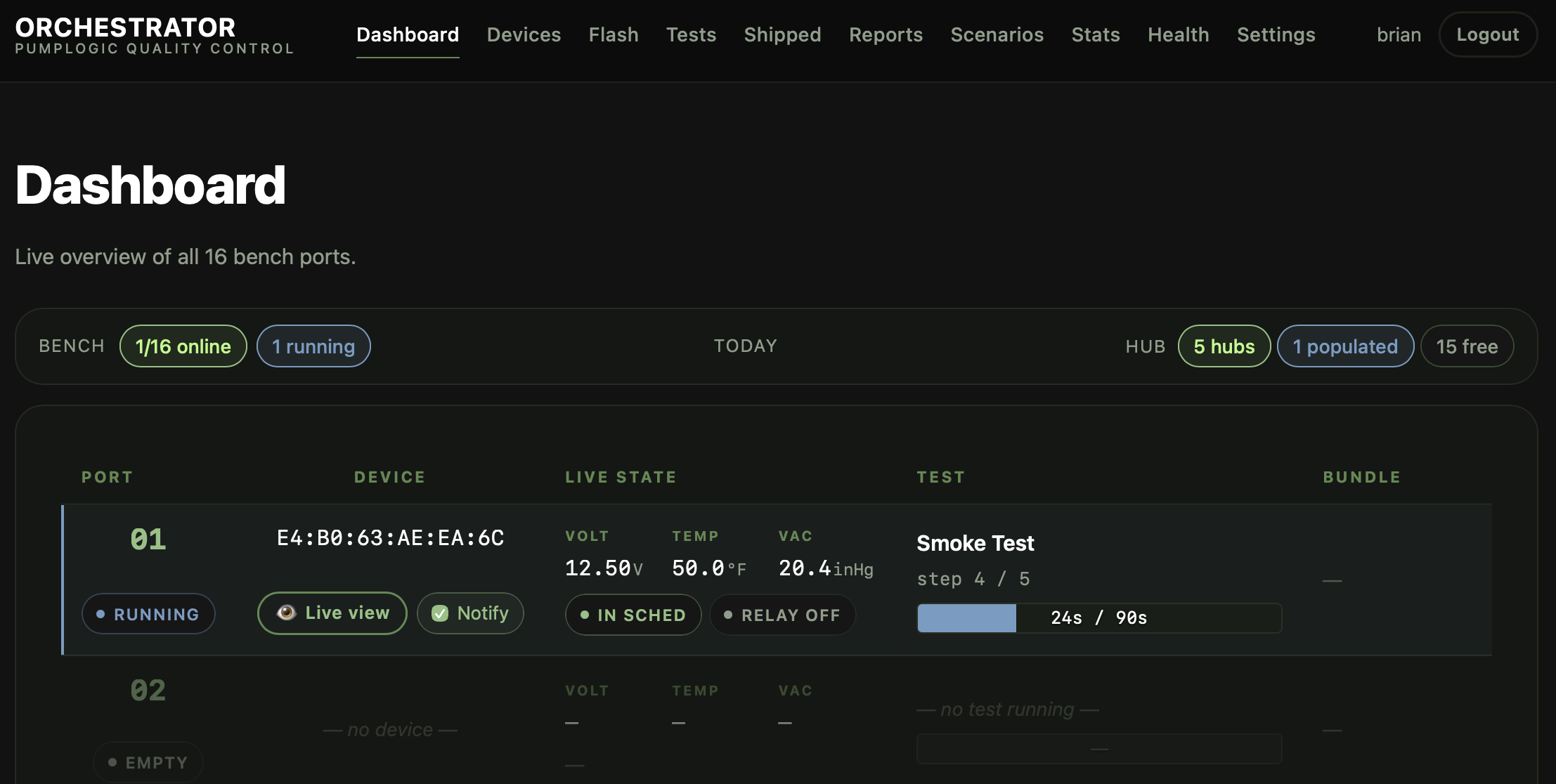
    Operator selects which devices and which scenarios to run from the test bench dashboard. Schedules can be queued — the 24-hour soak typically kicks off Friday at 5 PM and runs straight through the weekend.

  3. Execute — All Ten in Parallel

    The async test runner drives every device's HTTP API at once. Time-warp replays days of schedule logic in seconds. Threshold-flip exercises every sensor decision path. Each scenario, each assertion, logged as it happens.

  4. Report — Per Device, Per Assertion

    Live dashboard shows green checks and red X's as they land. A failure shows exactly which assertion broke, what was expected, and what was returned. When the batch is done, every passing unit gets its own digital test certificate — and only then does it leave the shop.

The unit you unbox
has already proven itself.

The Orchestrator exists for one reason: so the controller you wire up in your sugarhouse is the one we already shook down on the bench. Here's what that means in practice.

Individually Verified

No batch-sampling. No "tested at the factory" generality. Every single PumpLogic that ships has its own pass record, tied to its own MAC address.

Failures Caught Here, Not There

A bad relay or a flaky regulator is a bad day in our shop and a bad season in your sugarbush. We'd rather fail it on the bench, every time.

Burn-In Before Ship

A full 24-hour soak weeds out the units that "work for an hour" — the most common failure mode in any embedded device. If it survives the soak, it survives the season.

Traceable & Auditable

Every test run is logged with timestamps, assertions, and outcomes. If you ever need the full test record for your unit, we have it on file.

Built For PumpLogic

Generic test frameworks check generic things. The Orchestrator was designed from scratch around PumpLogic's exact API and behavior. It catches what matters.

Confidence In Every Box

When you receive a PumpLogic from MicroControl Systems, it has already answered 340+ questions correctly. You can wire it up knowing it works.

A digital pass record,
tied to your serial.

When your PumpLogic leaves our shop, it's because it earned a record like this:

Test Bench Pass Record · Sample
Device MAC A4:CF:12:8B:9E:42
Batch ID RUN-2026-0512-A
Scenarios Run 12 / 12 ✓
Assertions Passed 342 / 342 ✓
Soak Polls 1,440 / 1,440 ✓
Soak Duration 24h 00m 12s
RTC Drift +0.4 s / 24 h
Unexpected Reboots 0
CLEARED TO SHIP